RESEARCH DIRECTIONS + DES SCAFFOLDING
JUSTIN ZHANG - CARLETON UNIVERSITY, SWAN LAB
AGENDA
- 01Thank you - the detailed doc
- 02Research directions for our collaboration
- 03DES scaffolding walkthrough
- 04Questions I have
- 05Action items & next meeting
THANK YOU FOR THE DETAILED DOC
Three research directions I'm considering, then a high-level walkthrough of the mockup I've built from your spec.
DES TASK ORCHESTRATOR ARCHITECTURE
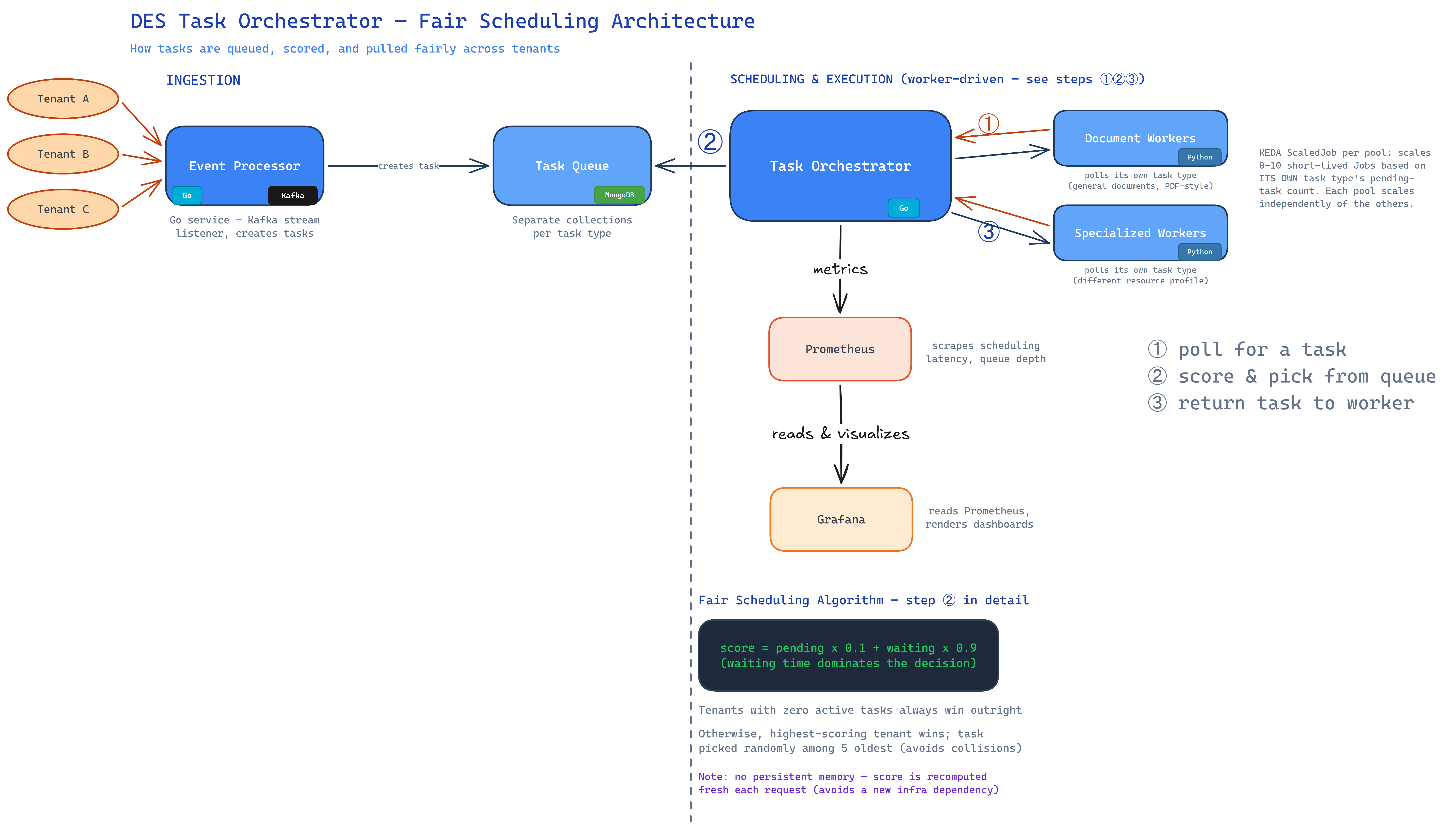
The orchestrator scores tasks and hands work to workers as they poll.
DIRECTION 1 - MEMORYLESS vs STATEFUL
Right now the orchestrator has “amnesia” - every time a worker polls, it computes the score from scratch and decides which task to hand over.
- Q1Does memoryless scheduling actually treat tenants fairly, or does it drift over time?
- Q2Could we sneak in one tiny counter per tenant (just a number piggybacked on an existing write) and recover most of the benefits of statefulness?
DIRECTION 2 - LEARNING THE WEIGHTS OFFLINE
In the current score formulation, 0.1 and 0.9 are hardcoded weights:
score = 0.1 * (Norm. backlog) + 0.9 * (Norm. wait time)DES already logs every scheduling decision it makes, so we could train an ML model on those historical logs without ever touching production. (This depends on whether you're open to sharing this data - if not, I can synthesize it, but it won't be realistic.)
Can an RL agent look at these logs and find better weights than 0.1 and 0.9?
DIRECTION 3 - PREDICTING TASK DURATION
Currently “wait time” just means how long a task has been sitting in the queue - but if we could predict how long a task will actually take, we could schedule smarter (e.g. priority to short-but-waited jobs).
- Q1Can a small ML model predict task duration from features like tenant, doc size, task type, etc.?
Note: a small model could add overhead since the score is recomputed on each worker poll - it needs to be really, really fast. - Q2If we swap “raw wait time” for “predicted remaining time”, does fairness get better or worse?
WHAT I'VE SETUP SO FAR
A mockup of your DES Task Orchestrator, built end to end so I can study the memoryless fair-scheduling rule under controlled, reproducible conditions.
Go service: the scheduler (DES), SQLite queue, HTTP API, metrics, KEDA external-scaler gRPC. The research artifact.
Python poll loop + processors, zero runtime deps. Each pool runs as a KEDA ScaledJob.
k8s + KEDA ScaledJob manifest templates, one per task-type pool.
IaC for the 2-VM split - provision, build, and deploy both VMs.
TWO-VM DEPLOYMENT TOPOLOGY
Deployed on two fresh Ubuntu 22.04 VMs, provisioned by Ansible from my machine (the controller).
- Installs: Go 1.27, builds the binary, systemd unit.
- Runs:
des-orchestratorservice, persistent SQLite queue, KEDA external-scaler gRPC.
- Installs: Docker, k3s, Helm, KEDA, worker image.
- Runs: k3s + KEDA + per-pool ScaledJobs.
- Image built locally, imported into k3s - never pushed to a registry.
THE QUEUE - SQLITE, ATOMIC CLAIMS
A single SQLite file. The atomic new > in_progress flip is one UPDATE ... RETURNING - a statement-level transaction, so concurrent workers can't double-claim.
CREATE TABLE IF NOT EXISTS tasks (
    id           TEXT PRIMARY KEY,
    tenant_id    TEXT NOT NULL,
    task_type    TEXT NOT NULL,
    document     TEXT NOT NULL DEFAULT '',
    status       TEXT NOT NULL,
    created_at   INTEGER NOT NULL,
    assigned_at  INTEGER,
    completed_at INTEGER,
    result       TEXT NOT NULL DEFAULT '',
    error        TEXT NOT NULL DEFAULT ''
);
THE HTTP API (WORKER-FACING)
GET /health- liveness.GET /tasks/available?taskType=X- worker poll; returns a Task JSON, or 204 if none.POST /tasks/{id}/complete- body{"result": "..."}; 204 on success.POST /tasks/{id}/error- body{"error": "..."}; 204 on success.GET /metrics- plain-text fairness + latency snapshot.
THE WORKERS - PYTHON, ZERO DEPS
A bounded-lifetime poll loop (spec 2.4): each KEDA Job processes some work and exits on MAX_TASKS / MAX_RUNTIME / N consecutive empty polls; KEDA respawns Jobs as depth warrants.
- poll > process > complete / error.
- Transient failures back off and retry - they don't kill the Job (KEDA owns its lifetime).
- stdlib
urllibHTTP client; no third-party packages.
Pure (document: str) -> str. Adding a pool = a module + a ScaledJob; the image doesn't change.
- comma_removal - strip every comma.
- word_count - count whitespace words.
- bleu_score - real corpus BLEU (brevity penalty + 1-4 gram) from stdlib.
QUESTIONS I HAVE
- Q1How should containerization or resource isolation be provisioned - is the current 2-VM setup okay?
- Q2My current implementation uses HTTP as the communication medium. Jayson mentioned it isn't HTTP and that it's event-based - what protocol is used?
- Q3What metrics are you using to measure fairness and latency? P99 per task? Jain's Fairness Index? How long the scheduler's Pick took?
ACTION ITEMS
- 01Replicate your enrichment system + pull key metrics. The DES mockup is built; next I run parameter sweeps (alpha / beta) and capture Jain's index and p99 latencies as a baseline.
- 02Literature study. Still revising my literature review. The current list focuses on batch LLM inferencing; I'm broadening it to include more on scheduling and distributed computing.
NEXT MEETING
THANK YOU
JUSTIN ZHANG - CARLETON UNIVERSITY, SWAN LAB